
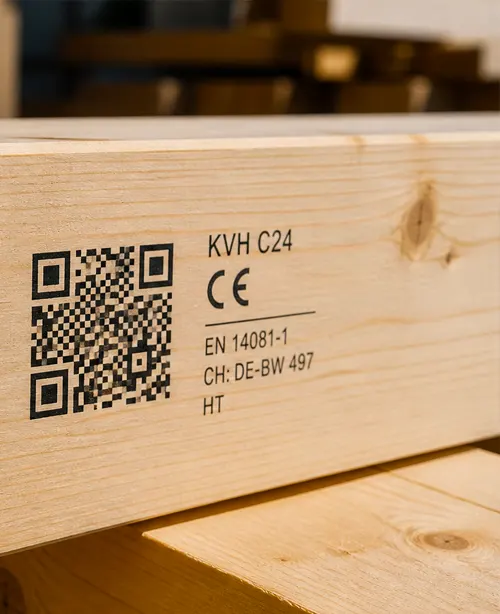
Marking of wood – consulting, solutions, products
Wood marking (lumber marking) is now an essential part of production for large parts of the timber industry (sawmills, carpenters, prefabricated house manufacturers, etc.).
Importance and basics of wood marking
Wood is a versatile material – but also a demanding one. Different surfaces, grain patterns, moisture levels and material densities place high demands on printing on wood as a direct marking solution. At the same time, industrial processes require increasingly seamless traceability, fast identification of components, durable marking directly on the material, and flexible labeling of changing formats and products.
Printing on wood in modern wood processing is far more than simple labeling. In sawmills, carpentry shops, prefabricated house factories and wood-processing industries, direct marking of wooden components is a key element of efficient production processes. Whether serial numbers, batch codes, dimensions, logos or assembly instructions – modern TIJ marking systems (thermal inkjet) and mobile handheld printers enable fast, precise and durable printing on wood surfaces.
What does “printing on wood” mean in an industrial context?
In an industrial environment, printing on wood refers to the direct, machine-based or manual marking of wooden surfaces with variable information.
Commonly printed information includes:
- Article numbers
- Production data
- Batch markings
- Dimensional information
- CE markings
- QR codes and barcodes
- Assembly instructions
- Company logos
- Quality labels
Marking is applied directly to:
- Sawn timber
- Structural timber
- OSB boards
- MDF boards
- Chipboard
- Glue-laminated timber
- KVH (construction timber)
- Pallet wood
- Prefabricated house components
TIJ marking systems: The solution for printing on wood (lumber marking systems)
TIJ marking systems (thermal inkjet) have established themselves as a highly efficient solution in the wood industry. They enable high-resolution, contactless printing directly on wood – fast, clean, and low-maintenance.
- Advantages of TIJ marking systems on wood
- Contactless printing – ideal for uneven wood surfaces
- High print quality – sharp text, codes and logos
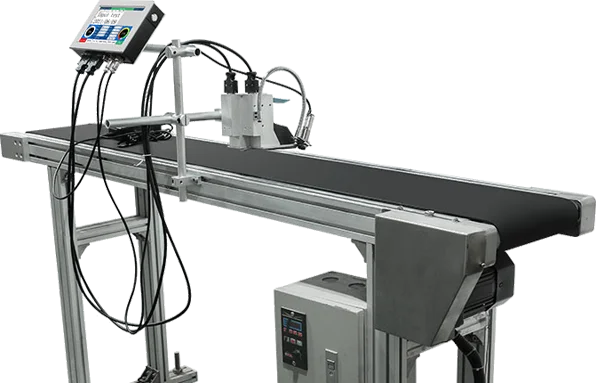
- Fast integration – into production lines and conveyor systems
- Low maintenance – cartridge-based system
- Flexible data handling – variable content in real time
- Fast-drying inks – suitable for absorbent wood surfaces
Especially in sawmills and automated wood production environments, TIJ systems stand out due to their high speed and low operating costs.
Handheld printers for wood: Mobile marking on site
In addition to stationary systems, mobile handheld printers for printing on wood are becoming increasingly important. They are particularly useful where large, bulky or already assembled wooden components need to be marked.
- Advantages of mobile handheld printers on wood
- Mobile and flexible in use
- Ideal for large workpieces
- Direct marking at storage locations or on construction sites
- Easy operation
- Perfect for single parts, small batches and re-marking
A handheld printer is especially practical when wooden components can no longer be run through a stationary production line.
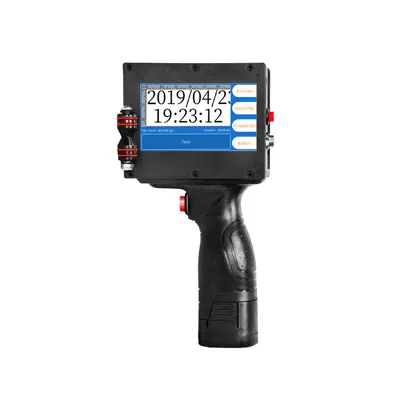
NasaJet® NJ-100
Handheld Printer
The affordable entry into the world of portable TIJ printing. Mark and label quickly and economically anywhere.
www.nasajet.com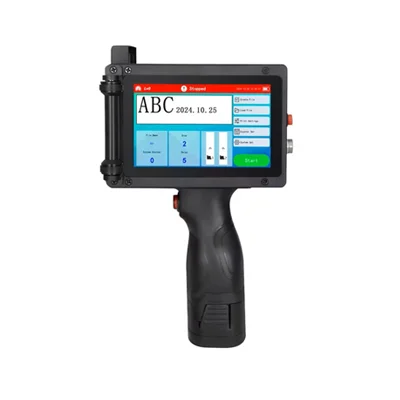
NasaJet® NJ-500
Handheld Printer
With two 1-inch TIJ cartridges, the NasaJet® NJ-500 achieves print heights over 50 mm. Large font printing in a portable format.
www.nasajet.com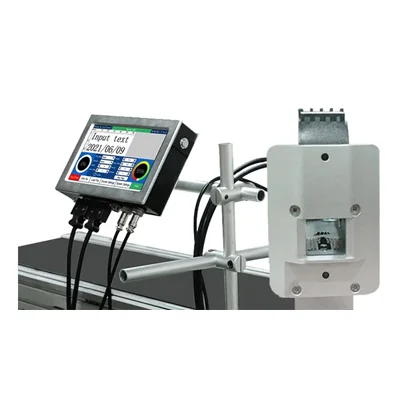
NasaJet® NJ-1000
Marking System
The NJ-1000 marking system is suitable for quickly upgrading existing production lines for simple labeling tasks.
www.nasajet.com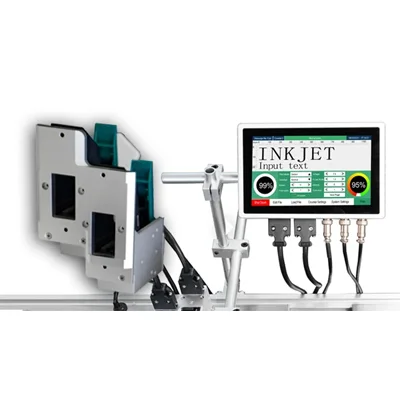
NasaJet® NJ-5000
Large Font Printer
The professional marking system for all requirements. Multiple print heads, parallel printing, and more.
www.nasajet.com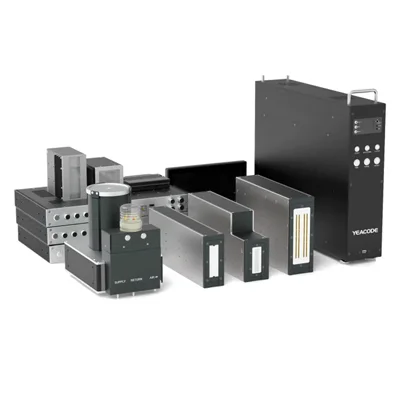
Yeacode Series 7
Marking System
Discover the Yeacode 7 Series, the marking system for the highest demands.
www.yeacode.de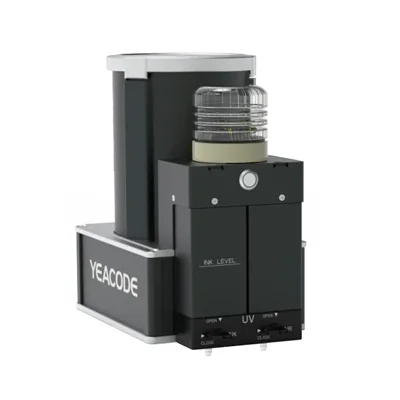
Yeacode CISS
Continuous Ink Supply System
Ensures consistent and uninterrupted ink supply for high-volume printing.
www.yeacode.de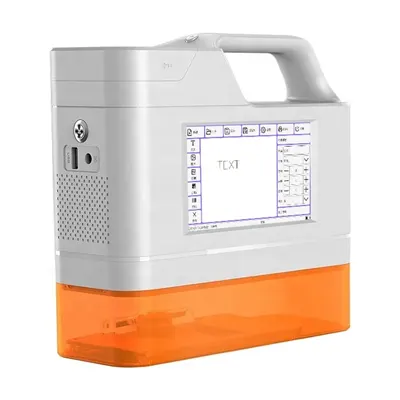
Laser Marking TL3pro
Laser Marking
Compact and portable laser marking device
Example applications for printing on wood in industry
The possible applications for printing on wood with TIJ marking systems and handheld printers are diverse. Especially in industrial wood processing, they create clear efficiency advantages.
1. Marking prefabricated house components
In prefabricated house production, wall elements, roof modules, beams and timber frames must be clearly identified. Direct printing on wood enables fast identification of each component.
Typical printed information:
- Component number
- Project assignment
- Installation side
- Installation direction
- Position marking
- QR code for digital assembly plans
With mobile handheld printers, even large wall elements can be marked directly in the production hall or before shipping.
Advantage: Fewer mix-ups, faster assembly, clean traceability.
2. Marking in sawmills
In sawmills, printing on wood is particularly important for tracking sawn timber and batches.
Directly after cutting, the following can be printed on boards, planks or beams:
- Cutting class
- Wood type
- Production batch
- Length / dimensions
- Sorting code
- Internal material number
TIJ marking systems can be integrated directly into conveyor lines and mark each workpiece during processing.
Advantage: Automated identification without additional manual effort.
3. Marking in carpentry and joinery workshops
In carpentry workshops, precise part identification is crucial, especially for custom-made products or serial furniture.
Application examples:
- Marking cabinet components
- Assembly markings on hidden surfaces
- Production numbers on MDF and chipboard
- Assignment of milled parts
- Marking customer orders
Mobile handheld printers are ideal for flexible workflows and changing workpieces.
Advantage: Fewer errors in assembly and picking.
4. Printing on KVH and glulam
Structural timber (KVH) and glued laminated timber must often be marked in compliance with standards.
Typical content:
- CE marking
- Strength class
- Manufacturer ID
- Production date
- Test codes
Here, direct printing on wood ensures compliant and durable marking without additional labels.
Advantage: Robust marking even during storage and transport.
5. Marking pallets and packaging wood
Printing on wood is also important in logistics. Pallets, crates and wooden transport packaging often require clear marking.
Printed information includes:
- Shipping data
- Recipient identification
- Batch numbers
- IPPC / export markings
- Internal logistics codes
Handheld printers allow flexible marking of pallets in warehouses or dispatch areas.
Advantage: Fast labeling without label consumption.
6. Marking wood panels and cut parts
In industrial panel processing, OSB, MDF, plywood or chipboard must often be marked directly before or after cutting.
Typical markings:
- Cutting numbers
- Commissions
- Dimensions
- Processing status
- CNC assignment
TIJ printing systems can be integrated directly into saws or processing centers.
Advantage: Improved process reliability in downstream processing.
Why TIJ is superior to labels and stamps
Many companies still work with labels or traditional stamps. In everyday industrial use, however, clear disadvantages become apparent:
- Labels detach under dust, moisture and rough surfaces
- Stamps are inflexible and require maintenance
- manual marking is prone to errors
- changing data is difficult to implement
TIJ marking systems and handheld printers solve these problems through direct, flexible and digital printing on wood.
Direct print as an efficiency factor in the wood industry
Industrial printing on wood is today a key component of efficient, safe and digitized production processes. Whether in sawmills, carpentry shops, prefabricated house production or wood logistics – modern TIJ marking systems and mobile handheld printers enable precise, flexible and economical marking directly on the material.
Companies benefit from higher process reliability, fewer mix-ups, better traceability, faster workflows and lower marking costs.
Anyone processing wood industrially can hardly avoid professional solutions for printing on wood. Modern TIJ printing systems provide the basis for efficient marking in networked wood production.
Lumber marking for sawmills and timber processing
Lumber marking is an important part of modern sawmill and timber processing operations. Boards, planks, beams and other sawn timber products often need to be identified directly during production, sorting, storage and shipping. Industrial marking systems make it possible to print variable information directly onto lumber surfaces, helping manufacturers maintain clear product identification and efficient material traceability throughout the production process.
Depending on the application, lumber marking can include product numbers, wood species, dimensions, production batches, sorting information, grades, quality information, barcodes, QR codes or company identification. The printed information can be generated automatically from production or ERP systems and transferred to the marking system in real time. This makes direct printing particularly suitable for sawmills and timber manufacturers processing different products, dimensions and batches on the same production line.
Direct marking of boards, planks and beams
Industrial lumber marking systems can print directly onto a wide range of wooden products. This includes sawn timber, construction timber, boards, planks, beams, structural timber and other wood products. Depending on the production process, marking can take place immediately after sawing, during sorting, before further processing or prior to storage and shipment.
TIJ marking systems are particularly suitable for applications where high-resolution, contactless printing is required. Because the print head does not need to physically contact the wood, variable information can be applied efficiently even when surfaces are uneven or when lumber is moving continuously through a production line. Fast-drying inks can also be selected according to the characteristics of the wood surface and the specific production requirements.
Automated lumber marking in sawmills
In automated sawmill production, lumber marking can be integrated directly into existing conveyor systems and production lines. Sensors and encoders can trigger the printing process while production data is supplied automatically to the marking system. This allows each piece of lumber to receive the appropriate information without requiring manual data entry for every individual workpiece.
For high-volume applications, automated lumber marking systems can therefore support consistent product identification and improve traceability from sawing and sorting through to further processing and dispatch. Variable information can be changed dynamically, making the technology suitable for production environments with frequently changing products, dimensions or batches.
Lumber marking for traceability and logistics
Clear identification is also important after the lumber has left the sawmill production line. Markings can help operators identify products during storage, picking and loading and can support the assignment of individual boards, bundles or batches to production data. Depending on the application, printed codes can also be used to connect physical lumber products with digital production or logistics information.
For example, barcodes and QR codes can provide a machine-readable link to product information, while text-based markings can communicate dimensions, batch numbers or sorting information directly to employees. This combination of human-readable and machine-readable information can support efficient workflows throughout modern timber processing operations.
For sawmills, timber manufacturers and other companies working with lumber, the choice of ink, print technology and marking system is particularly important. Wood surfaces vary considerably in terms of grain, porosity, moisture and surface condition. Geotechtronics therefore provides application-specific advice on lumber marking technology, industrial inks, print heads and system integration to develop a solution suited to the individual production process.