
Component Marking in Industry
The optimal solution always depends on the material, application and production environment.
Component Marking in Industrial Processes
Component marking is an important part of modern production and quality processes. Serial numbers, batch numbers, Data Matrix codes, QR codes, logos and other identification features make it possible to uniquely identify components and trace them throughout the entire product life cycle. Particularly in industries such as mechanical engineering, automotive, electronics, medical technology and aerospace, reliable marking tailored to the respective materials is essential.
Geotechtronics GmbH offers a range of technologies for industrial marking and supports companies in selecting the right system for their application. Depending on the material, surface, required durability and production process, TIJ marking systems, piezo printers and laser marking can be used.
What Is Component Marking?
Component marking refers to applying information directly to a component. This can include, for example, alphanumeric characters, serial numbers, production data, barcodes, Data Matrix codes, QR codes or individual identification numbers.
Industrial marking must achieve much more than simply being easy to read. Depending on the application, the marking may need to withstand abrasion, oils, chemicals, moisture, temperature loads or other environmental influences. At the same time, component marking should be reliable and integrate as efficiently as possible into existing production processes.
This makes marking an important part of industrial component identification and the traceability of products and components.
Direct Part Marking (DPM)
With Direct Part Marking (DPM), the identification is applied directly to the product or component. Unlike a separate label, the information is located directly on the surface of the component.
DPM methods are particularly useful when components need to remain clearly identifiable over a long period of time. Typical markings include:
- Serial numbers and individual component numbers
- Data Matrix codes and QR codes
- Batch and lot numbers
- Production and manufacturing data
- Type and model designations
- Logos and manufacturer identification
- Inspection and identification codes
Direct part marking enables individual components to be clearly identified and therefore supports traceability throughout complex production and supply chains.
Permanent Component Marking for Industrial Applications
Permanent component marking is particularly important when identification needs to remain intact throughout the entire life cycle of a product. This applies, for example, to components used in machinery, vehicles, equipment or safety-critical applications.
Which technology is suitable for permanent marking depends, among other things, on the material and the properties of the surface. Metal, plastic, painted surfaces and coatings each place different requirements on the marking process.
Selecting a suitable solution for industrial component identification therefore requires consideration of both the technical properties of the component and the conditions of the production process. Depending on the application, inkjet printing or laser marking may be the appropriate technology.
Component Marking on Metal and Plastic
Metal components are among the most common applications for industrial marking. However, stainless steel, aluminium, steel and other metal materials can have very different surface properties.
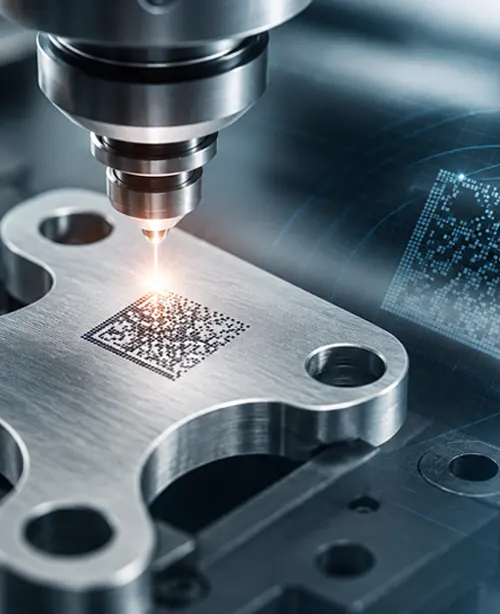
For permanent marking on metal components, laser marking offers particularly interesting possibilities. Depending on the material and the desired marking result, the surface can be selectively processed using a laser.
For plastic components, factors such as the type of plastic, colour, surface properties and the required durability play an important role. Here, industrial inkjet systems with suitable inks can provide a flexible marking solution.
The key consideration is therefore not only what information needs to be applied. The material, surface, production conditions and required durability of the marking are equally important.
TIJ Marking Systems for Industrial Component Marking
Thermal Inkjet (TIJ) provides a compact and flexible way to print variable information directly onto products and components. Modern TIJ marking systems can produce serial numbers, batch numbers, date information, barcodes and 2D codes, for example.
A key advantage of the inkjet process is contactless marking. The printhead does not need to mechanically touch the surface of the component. This makes the technology suitable for integration into a wide range of automated production processes.
Different inks are available for different materials and requirements. Depending on the application, factors such as adhesion, contrast, drying time and resistance can be decisive.
TIJ marking systems from Geotechtronics are therefore suitable for numerous applications involving industrial component identification and product marking.
Piezo Printers for Variable and High-Resolution Marking
In addition to TIJ technology, piezo printing technology offers further possibilities for industrial marking applications. Piezo printers also operate without contact and can be used for variable print information and a wide range of industrial marking processes.
Whether TIJ or piezo is the better solution depends on the specific application. Important selection criteria include print height, printing speed, print distance, resolution, ink, substrate and the required integration into the production line.
Geotechtronics supports companies in selecting the appropriate printing technology, taking into account the individual requirements of the respective production process.
Laser Marking for Particularly Durable Identification
When a particularly resistant and durable marking is required, laser marking can be a suitable solution. Depending on the material and process, the laser enables different types of surface processing.
A key advantage of laser marking is that no printing ink is required. This creates interesting possibilities for applications where high resistance to external influences is required.
Typical laser markings include serial numbers, Data Matrix codes, logos, type designations and other individual information.
Especially for demanding industrial applications, the laser system should be selected according to the specific material, surface and desired marking result.
Industrial Component Identification and Traceability
Industrial component identification is becoming increasingly important as production processes become more digital. A component is no longer just a physical product; its unique marking can be used to link it with information from production, quality management and logistics systems.
For example, an applied Data Matrix symbol can contain a unique identification number. This number can in turn be linked to information from an ERP, MES or quality management system.
This creates a connection between the physical component and its associated digital production data. Such marking can improve traceability and help make production and quality processes more transparent.
Which Component Marking System Is Right?
The selection of a suitable system should always be based on the specific application. Important questions include:
- What material needs to be marked?
- How large is the area to be marked?
- Which characters, codes or graphics need to be applied?
- What production speed is required?
- What level of durability must the marking provide?
- What is the distance between the printhead and the component?
- Is contactless marking required?
- What production and environmental conditions apply?
- Does the system need to be integrated into an existing production line?
Based on these requirements, it can be determined whether a TIJ marking system, a piezo printer or laser marking is the most suitable solution for the specific application.
NasaJet® NJ-100
Handheld Printer
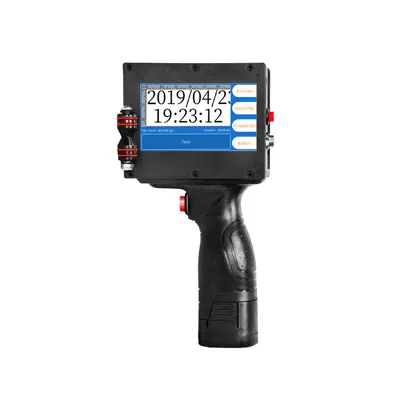
The affordable entry into the world of portable TIJ printing. Mark and label quickly and economically anywhere.
www.nasajet.com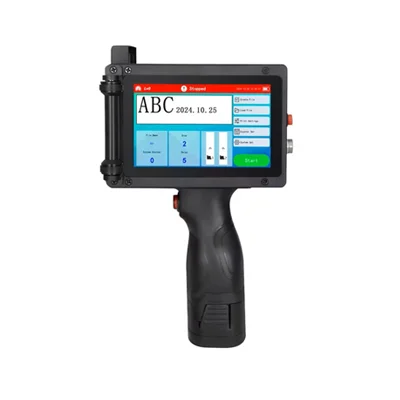
NasaJet® NJ-500
Handheld Printer
With two 1-inch TIJ cartridges, the NasaJet® NJ-500 achieves print heights over 50 mm. Large font printing in a portable format.
www.nasajet.com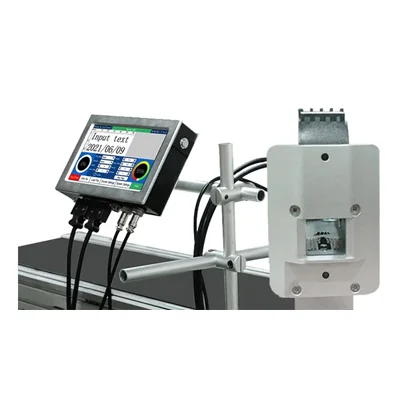
NasaJet® NJ-1000
Marking System
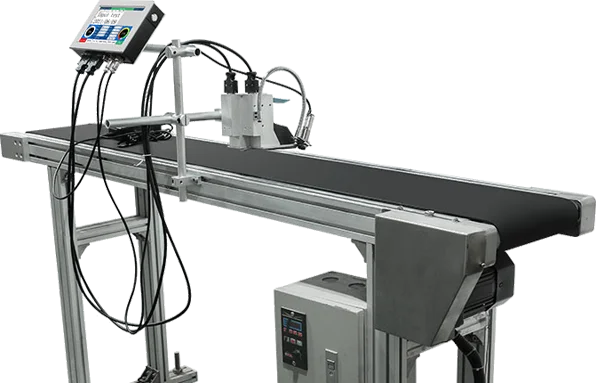
The NJ-1000 marking system is suitable for quickly upgrading existing production lines for simple labeling tasks.
www.nasajet.com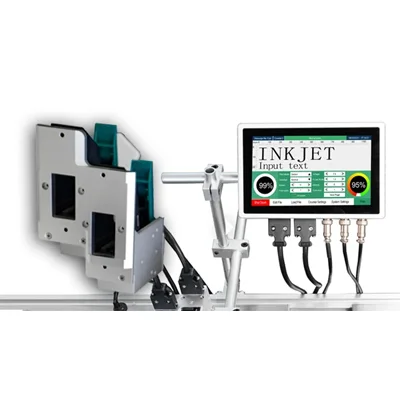
NasaJet® NJ-5000
Large Font Printer
The professional marking system for all requirements. Multiple print heads, parallel printing, and more.
www.nasajet.com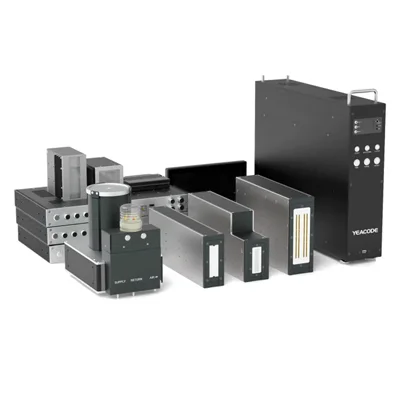
Yeacode Series 7
Marking System
Discover the Yeacode 7 Series, the marking system for the highest demands.
www.yeacode.de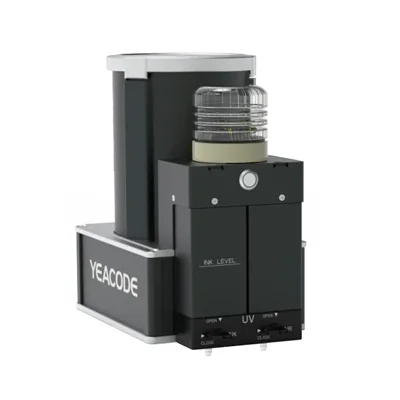
Yeacode CISS
Continuous Ink Supply System
Ensures consistent and uninterrupted ink supply for high-volume printing.
www.yeacode.de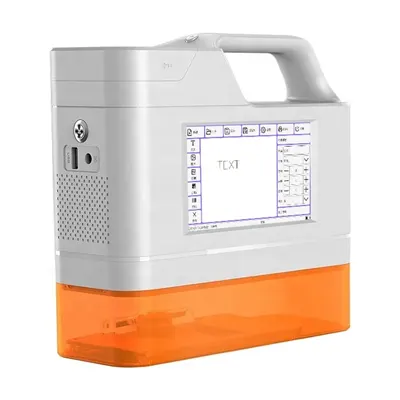
Laser Marking TL3pro
Laser Marking
Compact and portable laser marking device
Geotechtronics – System Provider for Component Marking
Geotechtronics GmbH provides companies with solutions for a wide range of industrial marking applications. By combining different technologies, the requirements of various materials, production processes and applications can be taken into account.
The portfolio includes TIJ marking systems, piezo printers and laser marking systems. This makes it possible to select the appropriate technology specifically according to the individual application.
Whether simple alphanumeric marking, variable serial numbers, barcodes, Data Matrix codes or particularly durable direct part marking: the key is always to find a technically suitable solution that can be reliably integrated into the existing production process.
Component Marking as Part of Modern Production Processes
Quality data can be linked directly to the respective component. This can make inspection processes and audits significantly easier.
Reliable component marking provides the basis for the unique identification of products and components. Particularly in automated and digitalized production processes, marking is increasingly becoming an interface between the physical product and its associated digital information.
Whether Direct Part Marking (DPM), permanent marking on metal components, marking of plastic components or component marking in the aerospace industry: the optimal solution always depends on the material, application, production environment and the requirements placed on the marking.