
Consulting and Products
Investing in modern TIJ technology is a crucial step to label and mark products accurately, flexibly, and future-proof.
Cost-Effective Product Labelling
In today's competitive manufacturing environment, precise and reliable product labelling is essential. Whether for food, beverages, pharmaceuticals, or industrial components, product marking not only supports logistics and traceability but also fulfills regulatory requirements. Modern technologies, especially in the field of Thermal Inkjet (TIJ) marking systems and TIJ handheld printers, offer companies versatile options to label and mark their products efficiently.
The choice between a stationary TIJ marking system and a handheld TIJ printer depends on various factors. Production volume, material type, product shape, and the required print resolution play a decisive role. While stationary systems excel in automated production lines, handheld printers provide flexibility for smaller batches or products with irregular shapes.
What is Product Labelling and Product Marking?
Product labelling includes all information permanently applied to a product or its packaging. This can include expiration dates, batch numbers, barcodes, QR codes, serial numbers, or logos. Product marking refers to the actual process of physically applying this information to the product – whether by printing, embossing, or labeling. In many industries, accurate labelling is legally required, while in others it supports production control and quality assurance.
Advantages of TIJ Marking Systems
Thermal Inkjet (TIJ) printers have proven to be particularly flexible and cost-effective. Unlike other marking technologies, TIJ printers operate contact-free and deliver high-quality print images on a wide variety of materials such as cardboard, film, metal, or plastic. Key advantages include:
- High print quality: Sharp codes, logos, and text even at small font sizes.
- Easy integration: TIJ systems can be easily incorporated into existing production lines.
- Low maintenance: No dryers or complicated cleaning processes required, as ink cartridges are easy to replace.
- Versatility: Suitable for a wide range of surfaces and product shapes.
TIJ handheld printers extend these advantages with maximum flexibility. They are especially suitable for manually marking individual products or batches that cannot be processed automatically. With ergonomic design and simple operation, they also allow quick adjustments, for example when printing special batches or small series.
Applications
The choice between a stationary TIJ marking system and a handheld TIJ printer depends on various factors. Production volume, material type, product shape, and required print resolution play a decisive role. While stationary systems excel in automated production lines, handheld printers provide flexibility for smaller batches or for labelling and marking products with irregular shapes.
Product Labelling with Stationary Devices
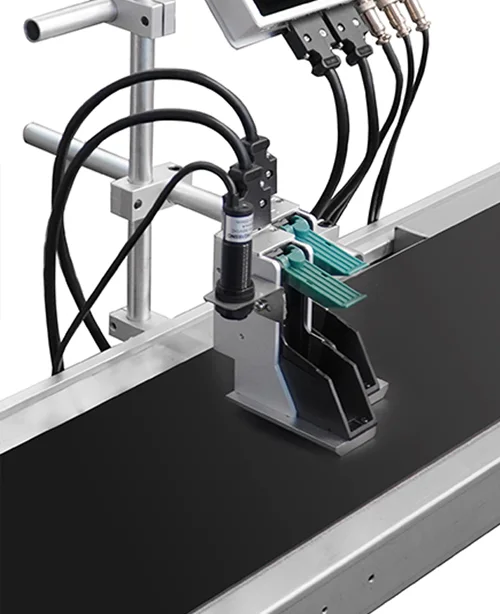
TIJ marking systems are integrated directly into production lines, enabling automated, continuous product labelling and marking.
Typical Applications
- Carton marking in the food industry
- Printing on secondary packaging
- Direct printing on wood, metal, or plastic
- Marking of bags and construction material packaging
Technical Features of Modern TIJ Large-Character Printers
- Multiple print heads can be combined
- Print heights from a few millimeters up to over 100 mm
- Network and database connectivity
- Integration into ERP or MES systems
- Printing of text, logos, barcodes, and QR codes
Modular expansions allow printing systems to be precisely adapted to production requirements.
TIJ Handheld Printers – Mobile Large-Character Printing
Product labelling with mobile devices.
Advantages of TIJ Handheld Printers
- Mobile and flexible to use
- Ideal for small batches or retroactive marking
- No fixed installation required; battery-operated
- Easy operation via touchscreen
TIJ Handheld Printers are especially suitable for:
- Construction site marking
- Warehouse and logistics processes
- Direct printing on large components
- Wood and pallet marking
- Printing on concave and convex surfaces
Mobile product labelling offers significant advantages, particularly for irregular or large objects.
TIJ Product Labelling vs. Traditional Marking Systems
| Criterion | TIJ Large-Character Printers | Valve Printers | CIJ Systems |
|---|---|---|---|
| Maintenance | Very low | Medium | High |
| Print Resolution | Very high (up to 600 dpi) | Low | Medium |
| Investment Costs | Moderate | High | High |
| Ease of Use | Simple & intuitive | Medium | Complex |
| Mobile Use | Yes (handheld printers available) | No | No |
| Printing Variable Data | Highly suitable | Limited | Suitable |
| Integration into Production Lines | Very flexible | Limited | Good |
TIJ Product Labelling for Different Industries
- Automotive Suppliers
- Logistics & Shipping
- Food Production
- Beverage Industry
- Chemical Industry
- Wood & Construction Materials
TIJ systems have a clear advantage in environments with changing data and varying surface types.
Sustainability & Efficiency with Thermal Inkjet
TIJ systems use replaceable ink cartridges that combine printhead and ink. This reduces maintenance requirements and downtime. Additionally, companies benefit in product labelling from:
- Low energy consumption
- Reduced consumables
- Minimized machine downtime
- Lower service costs
Consulting as a Success Factor: Product Labelling
Selling marking systems for product labelling and product marking is more than just selecting a device. Expert consulting is crucial to achieve optimal results in the long term. At Geotechtronics, we combine years of experience with a broad product portfolio to provide tailored and cost-effective solutions for your individual labelling challenges.
- Selection of suitable control electronics and printheads
- Recommendation of appropriate inks
- Integration into conveyors and control systems
- Employee training
- Service and support concepts
- ...
Integration into Existing Systems
Modern marking systems for product labelling must be Industry 4.0 ready.
TIJ marking systems can be integrated flexibly:
- Stand-alone or line-integrated
- Control via PLC
- Automatic data input
- Sensor and encoder connectivity
- ...