
Advanced product marking
UV ink provides companies with an effective way to mark products, packaging, and components invisibly.
Invisible marking for production, logistics and product protection
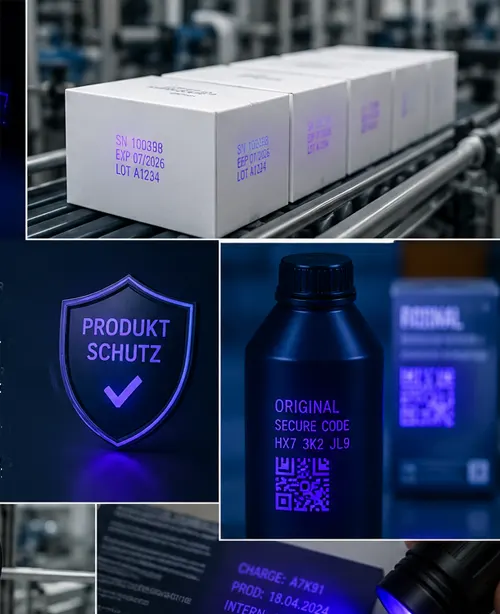
UV ink is a special type of industrial marking ink that remains virtually invisible under normal lighting conditions and only becomes visible under UV light. This enables concealed markings that are not perceptible to the human eye in everyday use, yet can be quickly and reliably verified when needed.
In combination with modern TIJ (Thermal Inkjet) marking systems, UV ink opens up numerous possibilities for product identification, quality assurance, traceability, and protection against counterfeiting. Companies in industry, retail, and logistics increasingly use this technology to store additional information on products and packaging without altering their appearance.
What is UV ink?
UV ink (often also referred to as UV fluorescent ink, invisible ink, or security ink) contains special fluorescent pigments or dyes. These react to ultraviolet radiation and become visible under UV light.
Depending on the formulation, UV ink may be completely invisible under daylight or only faintly visible as a subtle marking. When the product is illuminated with a UV lamp or a corresponding inspection device, the printed information becomes clearly visible.
This technology has been used for many years in security applications and is now also firmly established in industrial marking processes.
Why UV Ink is used in industrial marking
Many companies require information on products or packaging that should not be visible to end customers. At the same time, this data must always be available for internal inspections, recall actions, or authentication processes.
With UV ink, such information can be applied directly without affecting the packaging design, brand image, or product appearance. This creates an additional marking layer that is only accessible to authorized personnel.
This is particularly advantageous for high-value products, safety-critical components, or complex supply chains. The marking can be used, for example, for internal batch tracking, quality inspections, or as an authenticity feature.
UV ink and thermal inkjet technology
Modern TIJ printers are ideally suited for the use of UV inks. The technology enables high-resolution print images with small font sizes and precise codes.
Even complex DataMatrix codes, QR codes, serial numbers, or alphanumeric markings can be reliably applied. High print quality is particularly important because markings are often machine-readable or checked as part of quality control processes.
In addition, TIJ marking systems can be easily integrated into existing production lines. Marking is contactless and can be applied to a wide variety of materials.
Applications of UV ink
Advantages of UV ink for industrial applications
The greatest advantage of UV ink is the invisibility of the marking. Companies can apply additional information without changing the design of products or packaging.
Another key benefit is the high flexibility of modern TIJ marking systems. Variable data, serial numbers, barcodes, or individual security codes can be printed in real time. This makes the technology suitable for both small batch sizes and highly automated production lines.
A further advantage is the ease of verification. Compact UV handheld lamps already enable quick on-site inspection. In most cases, no complex analysis methods or special reading devices are required.
In addition, UV markings can be used as an additional security layer without modifying or adding visible markings.
:contentReference[oaicite:0]{index=0} – Your partner for industrial marking solutions
The :contentReference[oaicite:1]{index=1} supports companies in implementing modern coding and marking solutions across the entire production and supply chain. The service portfolio includes not only high-performance TIJ marking systems for industrial printing, coding, and traceability, but also consulting, integration, and optimization of complete marking processes. In addition, Geotechtronics supplies suitable consumables for a wide range of applications – from standard inks for paper and cardboard to specialty inks such as UV ink for hidden security and identification marking. Customers benefit from practical consulting, many years of experience in industrial marking, and individually tailored solutions for production, packaging, logistics, and trade.