
Consulting, Solutions, Products
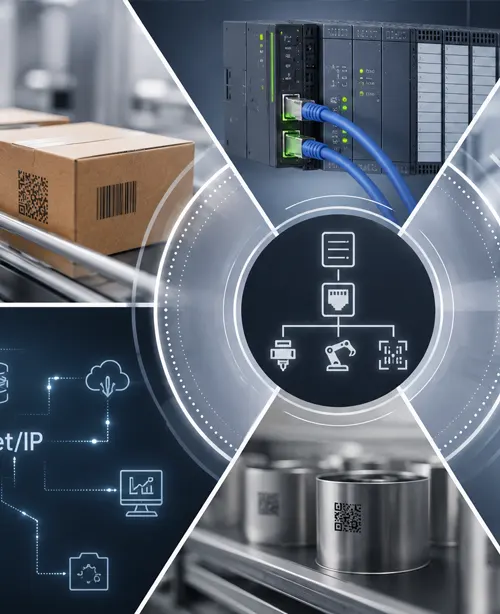
Product traceability is becoming increasingly important across nearly every industry. This is exactly where modern EtherNet/IP printing systems come into play.
Product Marking in Networked Production Environments
Industrial product marking has changed fundamentally in recent years. Where simple date coders or manual labeling systems were once sufficient, companies today face far more complex requirements. Production lines are becoming smarter, processes more automated, and product traceability is gaining importance across nearly every industry.
In highly automated manufacturing environments, marking systems must not only print reliably but also integrate seamlessly into existing production and control structures. Especially in combination with PLC systems, robotics, and digitalized manufacturing processes, EtherNet/IP is increasingly becoming the standard for industrial communication.
A powerful EtherNet/IP printing system enables direct communication between the printing system, PLC control systems, sensors, and production equipment. This creates efficient, automated, and error-free marking processes that can be flexibly adapted to different production requirements.
What is an Ethernet/IP printing system?
Ethernet/IP is an industrial communication protocol based on standard Ethernet. It was specifically developed to meet the requirements of modern automation technology and enables fast data exchange between machines, controllers, and peripheral devices.
An Ethernet/IP printing system is therefore an industrial marking or coding system that communicates directly via Ethernet/IP with PLC controllers and production systems. Typical applications include:
- Product labeling
- Batch coding
- Serial number assignment
- QR code and barcode printing
- UDI and track & trace solutions
- Direct marking on components
- Packaging labeling
- Automated labeling
In particular, in modern smart factory concepts, direct communication between the printing system and the PLC is crucial. Production data can be processed in real time and automatically transferred onto products or packaging.
Ethernet/IP and PLC – the foundation of modern automation
In many manufacturing companies, the PLC forms the heart of the entire production process. It controls machines, conveyor systems, sensors, and robotic systems. Modern marking solutions must therefore be fully PLC-capable.
By integrating an Ethernet/IP printing system into the PLC environment, significant advantages arise:
Direct communication with the control system
Production data is transmitted directly from the PLC to the printing system. This allows dynamic adjustment of print content – for example depending on product variant, batch, or production order.
Higher process reliability
Manual interventions are reduced. Errors caused by incorrect inputs or faulty label templates can be significantly minimized. This improves quality and reduces scrap.
Real-time capability
In modern high-speed production lines, every millisecond counts. Ethernet/IP printing systems enable fast and stable communication between the printing system and the automation environment.
Flexible production control
Especially in environments with frequently changing products or small batch sizes, automated print data management is essential. PLC-controlled marking systems enable quick switching between different print layouts without interrupting production.
Industrial printing systems for demanding production environments
Modern Ethernet/IP printing systems are used across numerous industries, including:
- Automotive industry
- Food production
- Packaging industry
- Medical technology, pharmaceutical industry
- Electronics manufacturing
- Plastics industry
- Metal processing
- Logistics and intralogistics
- Horticulture businesses (plant passport)
The requirements vary significantly. While the food industry primarily demands fast and hygienic labeling solutions, the automotive sector focuses on durable direct marking and full traceability.
Professional providers therefore develop customized solutions that are precisely tailored to production processes, materials, cycle times, and environmental conditions.
Handheld printers, TIJ systems and industrial coding
Thermal Inkjet systems (TIJ) in particular have become widely established in industrial product marking. They offer high print quality, low maintenance, and flexible integration options. TIJ printing systems are ideally suited for:
- QR codes, barcodes
- Date coding
- Serial numbers
- Variable data
- Logos and graphics
- High-resolution marking
Combined with Ethernet/IP, they create powerful solutions for modern industrial plants. The systems can be directly controlled via the PLC and easily integrated into existing production lines.
Handheld printers are also becoming increasingly important. They offer flexible marking options for large components, pallets, cartons, or hard-to-reach products. Modern devices also support industrial networks and can become part of a fully digitalized production environment.
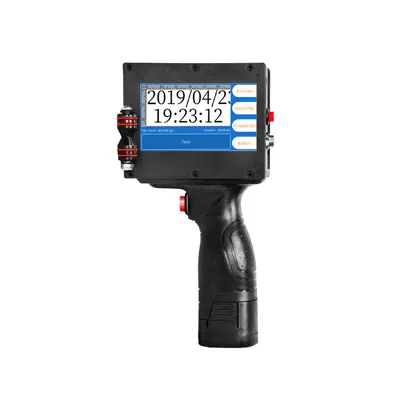
NasaJet® NJ-100
Handheld Printer
The affordable entry into the world of portable TIJ printing. Mark and label quickly and economically anywhere.
www.nasajet.com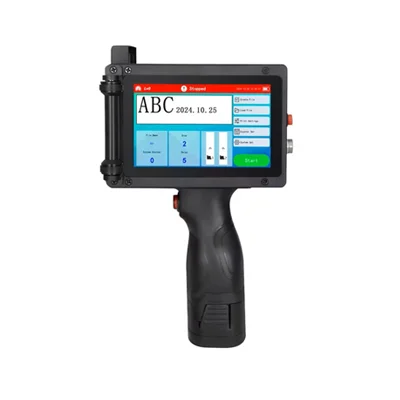
NasaJet® NJ-500
Handheld Printer
With two 1-inch TIJ cartridges, the NasaJet® NJ-500 achieves print heights over 50 mm. Large font printing in a portable format.
www.nasajet.com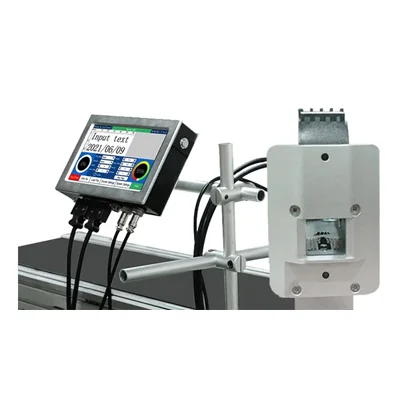
NasaJet® NJ-1000
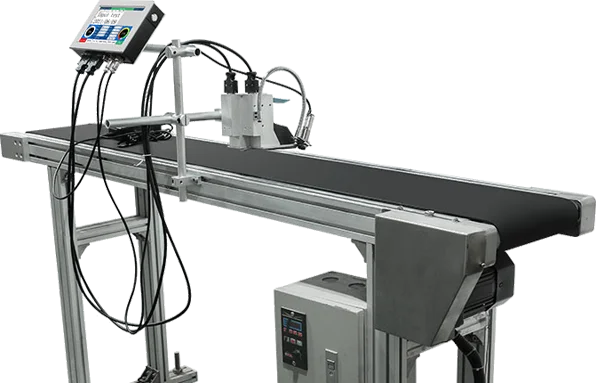
Marking System
The NJ-1000 marking system is suitable for quickly upgrading existing production lines for simple labeling tasks.
www.nasajet.com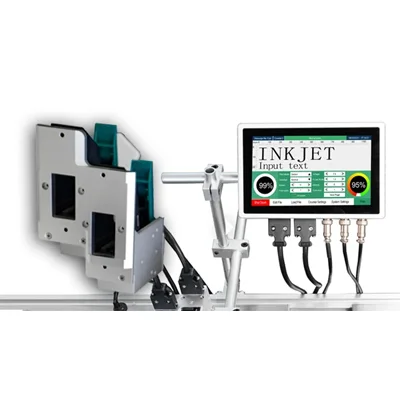
NasaJet® NJ-5000
Large Font Printer
The professional marking system for all requirements. Multiple print heads, parallel printing, and more.
www.nasajet.com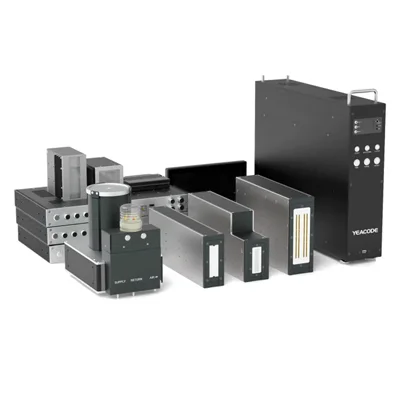
Yeacode Series 7
Marking System
Discover the Yeacode 7 Series, the marking system for the highest demands.
www.yeacode.de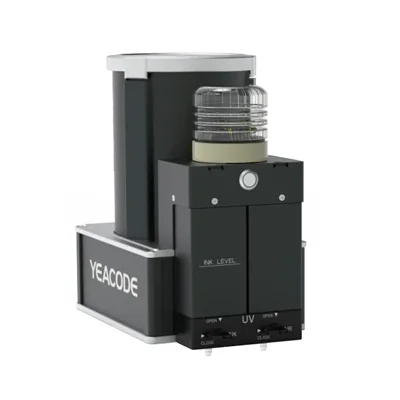
Yeacode CISS
Continuous Ink Supply System
Ensures consistent and uninterrupted ink supply for high-volume printing.
www.yeacode.de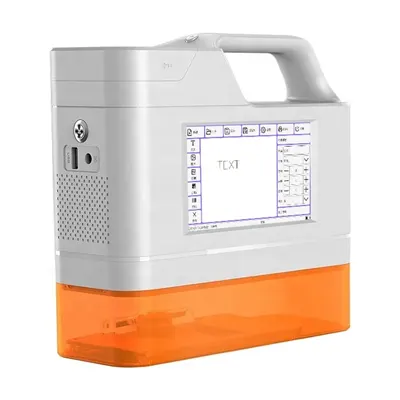
Laser Marking TL3pro
Laser Marking
Compact and portable laser marking device
Robotics and automated marking systems
A future-oriented Ethernet/IP printing system does not end with the printer itself. Increasingly, complete robotics and automation solutions are being implemented. In this context, robots take over tasks such as:
- precise positioning of the print head
- product handling
- automatic part feeding
- marking complex component geometries
- integration into production cells
This enables highly precise marking processes with maximum repeat accuracy, especially in the automotive and metalworking industries.
Communication between robotics, PLC, and printing system is centrally managed via industrial networks such as Ethernet/IP. This allows all process steps to be synchronized and monitored.
Track & Trace as a key element of modern manufacturing
Product traceability is becoming increasingly mandatory in many industries. Modern Ethernet/IP printing systems play a crucial role in this context.
By directly connecting to ERP, MES, or PLC systems, variable data can be generated and printed automatically, including:
- Serial numbers
- Batch numbers
- Production times
- Machine IDs
- Individual product data
QR codes and DataMatrix codes enable seamless traceability throughout the entire supply chain. At the same time, modern marking systems support automatic print quality verification.
Customized consulting and tailor-made solutions
Every production environment places different demands on an industrial printing system. Therefore, professional consulting is especially important.
An experienced provider like us does not only analyze the required marking but considers the entire production process:
- existing PLC structures
- network architecture
- production speed
- material properties
- environmental conditions
- degree of automation
- future expansion possibilities
Based on this, individual solutions are created that are both technically and economically convincing. Today, it is no longer just about individual printers. What is required are holistic concepts consisting of hardware, software, PLC integration, robotics, and process integration.
Future-proof Industry 4.0 solutions
Through full connectivity, production data can be centrally managed, processes monitored, and marking dynamically controlled. At the same time, intelligent marking systems create the foundation for:
- predictive maintenance
- digital production documentation
- automated quality control
- intelligent production control
- cloud-based production analytics
Companies benefit from higher efficiency, lower error rates, and maximum transparency across their production processes.